
Build your own models.
Orchestrate Claude Code, Codex, and your own agents, then turn their work into datasets, evals, and models that continually improve with reinforcement learning.
OpenPond Desktop
Orchestrate Claude Code, Codex, and your own agents, then turn their work into datasets, evals, and models that continually improve with reinforcement learning.
Keep the conversation, tools, files, changes, and result together. Work beside local projects or use an isolated cloud sandbox when you need more room.
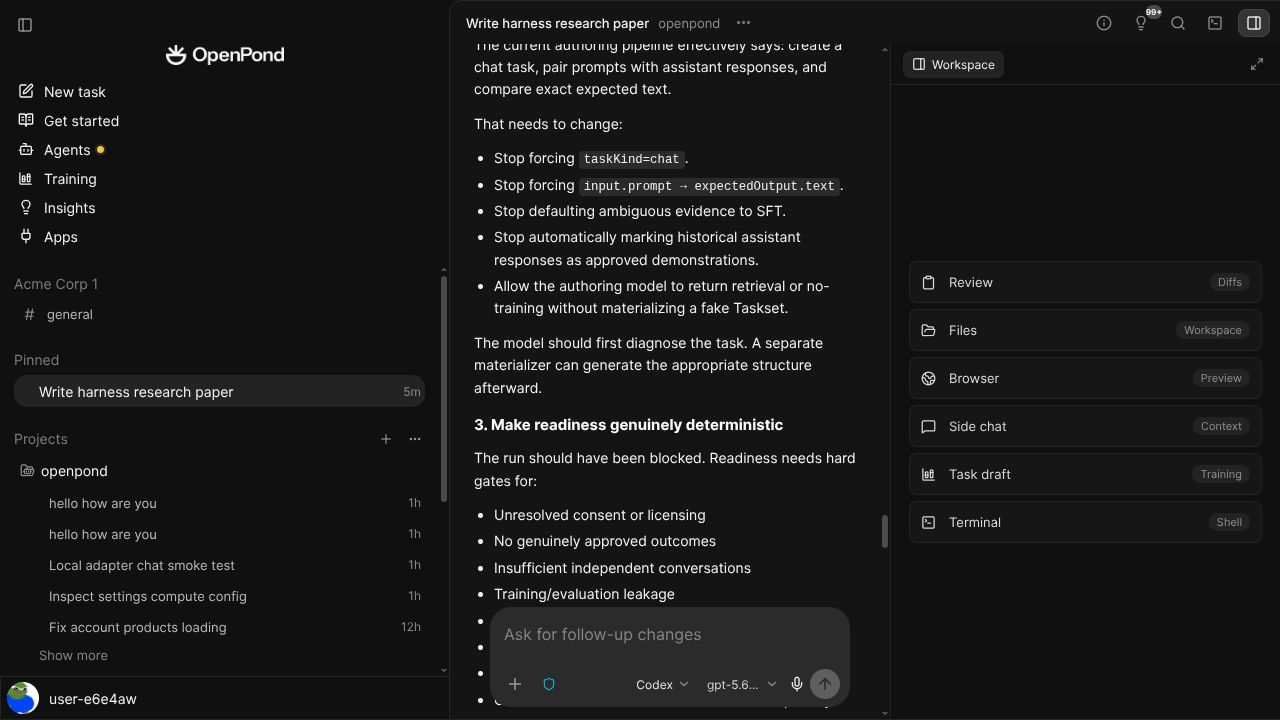
Refiner reviews completed tasks and looks for improvements that can help with future work. Useful changes become recorded, testable Harness updates. If no change is justified, nothing changes.
Work with local projects or cloud sandboxes. The conversation, tools, files, changes, and result stay together.
Refiner reviews completed tasks and looks for reusable improvements that can help with future work.
Update the Harness first. Create Tasksets, run evaluations, and train a model only when the evidence supports it.
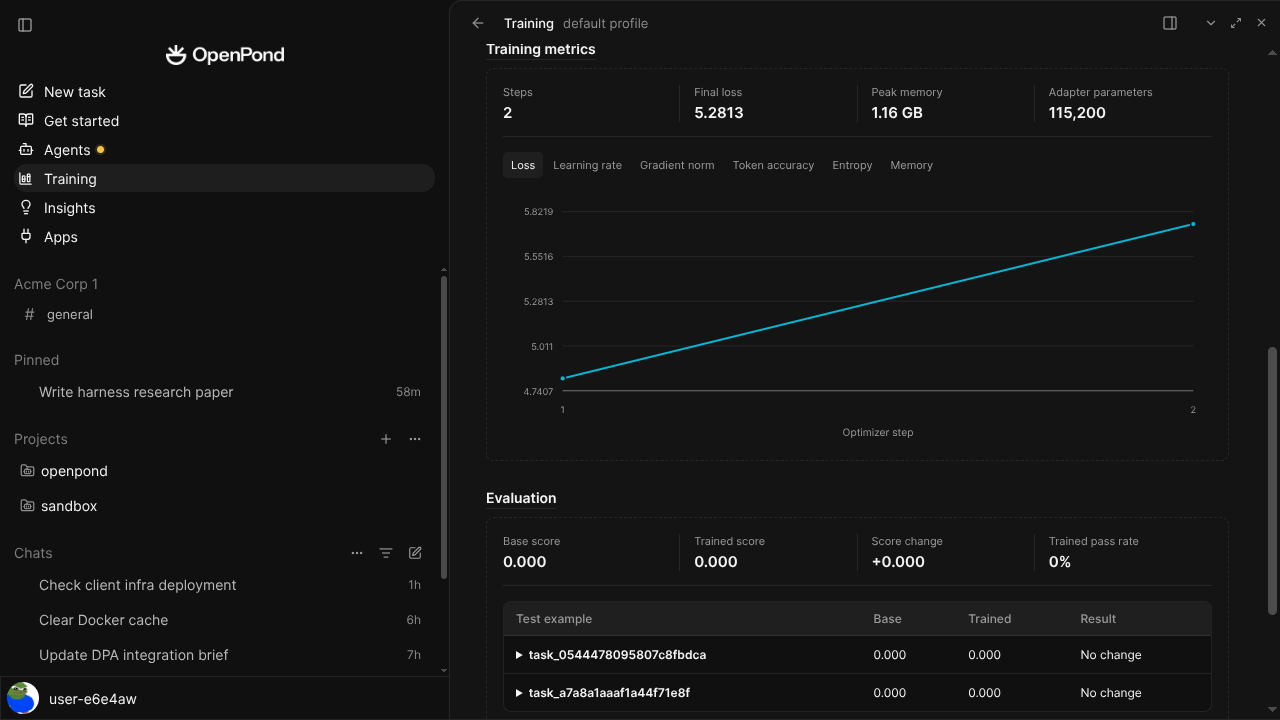
Managed reinforcement learning
Compare a baseline, inspect reward variation, run bounded GRPO or RFT, and preserve the resulting adapter with its complete recipe. A failed hypothesis is still a useful result.
Explore Tasksets →OpenPond Desktop, CLI, TUI, local runtime, Tasksets, and the training workbench live together. Run locally without an OpenPond account, inspect the contracts, and bring in the web app when the work needs cloud execution or a team.
Read the documentation →Start from the terminal
npx openpond@latestThe same source-backed agent can run beside a local project in Desktop, the CLI, or the TUI, and continue in OpenPond Cloud from the web.
Read straightforward, sourced comparisons across AI work products and open-source agent harnesses.
Explore all comparisons →