
Ponder Training
Post-train models with supervised fine-tuning and reinforcement learning.
Review costs before you start.
- Training
- Compute time
- GPU + CPU task execution
- Review your hardware, billing mode and estimated run cost before starting SFT or RL.
- Model serving
- Serving time
- rate shown before activation
- Choose a model and serving configuration, then review startup and idle-time charges.
- Model calls
- Token usage
- evaluation + grading
- Calls to external models use the selected model’s published rates.
From dataset to deployed model.
- 01
Prepare your data
Bring examples of the behavior you want. Review training targets, version your dataset, and keep validation examples separate.
- 02
Choose how to train
Use supervised fine-tuning for approved answers, or reinforcement learning for tasks with a measurable reward. Review the estimated cost and spending settings before starting.
- 03
Compare and deploy
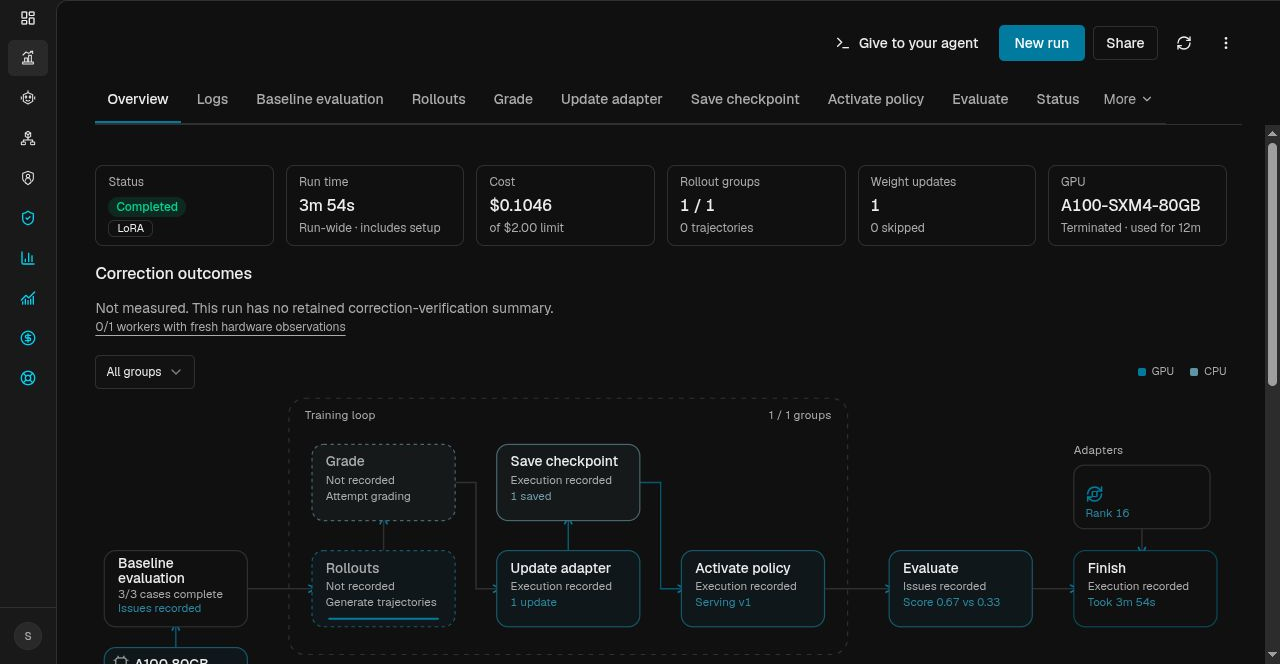
Evaluate the candidate against your baseline on the same task panel. Inspect the results, then choose the version to serve through the API.
Teach the answer.
Or reward the outcome.
Choose the learning signal that matches your task. Both paths retain the training configuration and candidate version so you can inspect what changed.
Supervised fine-tuning
SFTTrain on reviewed input-and-answer examples. Useful when you can show the model the correction, response, or tool call it should produce.
Reinforcement learning
RLDefine a task and a grader. Score rollouts against the outcome you care about, and use that reward signal to train the model.
Keep the evidence.
Choose what goes live.
A finished training run creates a candidate. Evaluation tells you whether it is worth using. Keep that decision connected to the data, recipe, and model version that produced it.
- Datasets and rewards
- Versioned examples, reviewed training targets, and task-specific graders.
- Runs and checkpoints
- Inspectable progress, retained adapters, and an explicit spending boundary.
- Evaluation and serving
- Baseline comparisons, candidate versions, and API access to the model you select.
Build your next model.
Start with a dataset, a baseline, and a clear idea of what better looks like.
Want to learn from your agent’s tool errors? Explore Ponder Fix-it.