
Inside the Refiner Loop
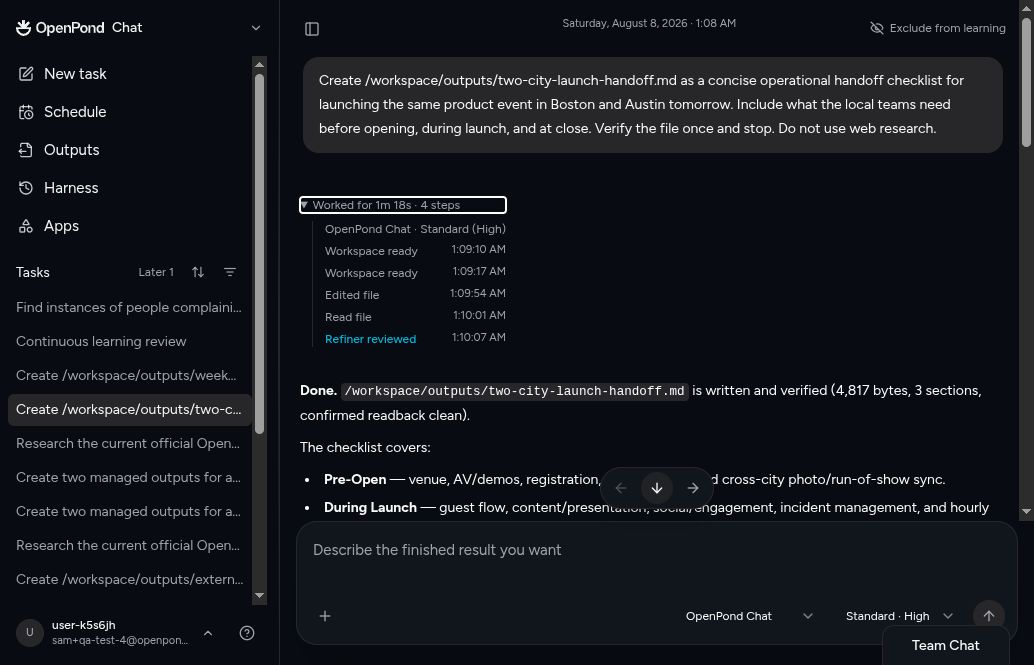
Refiner reviews completed work after the foreground response has settled. Its job is not to silently rewrite a model or read an account's entire history. It looks for a small, reusable correction that belongs to the Harness—and it can decline to act.
The evidence packet is deliberately bounded
Refiner receives the request, user-visible result, normalized tool failures and recovery, short event excerpts, diagnostics, immutable Harness sources, and eligible memory, prompt, Skill, and Agent targets.
It excludes secrets, raw credentials, unrestricted connected-app data, unbounded transcript archives, and unrelated private workspace content. Evidence is constrained by host authorization and byte, time, and cost bounds.
The outcome may be no action
After review, Refiner may return no_action, propose a small Harness update,
or route the issue to the runtime/product, Taskset, or training owner. A task
failure alone is not enough. The system needs evidence that a behavior is
reusable, owned by the Harness, within an advertised capability, and suitable
for critique and validation.
Changes are inspectable and reversible
An accepted change becomes a new immutable Harness release. That preserves lineage, lets later work use the reviewed version, and provides a rollback point. It is distinct from model-weight training, which needs a Taskset, frozen baseline, learning signal, budget, candidate evaluation, and activation decision.
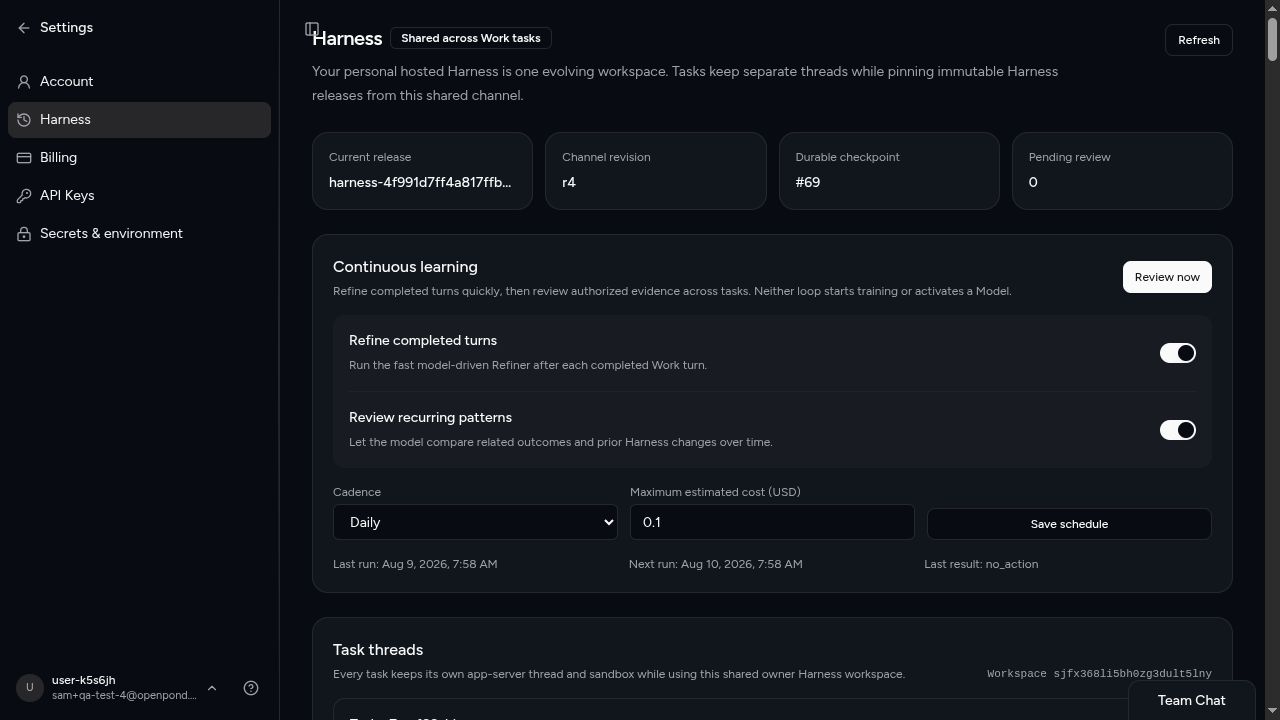
Refiner makes the smallest supported change, records why it was allowed, and keeps a rollback point. See Refiner evidence for the precise boundary.