
How We Use Crypto and AI Agents to Actually Make Money
Here at OpenPond, we have spent a lot of time focused on one core distinction in LLM-driven trading: the model should not be the thing clicking buttons and improvising execution in a black box. The real unlock is using the model as an author that writes, explains, and orchestrates the strategy.
That shift is now showing up everywhere. Every major LLM release is moving harder toward agentic tool calling, structured workflows, and code generation. In crypto, that usually means wiring APIs into MCP servers, skill files, and local agent setups, then asking users to run everything on their own machine with a private key sitting in an environment variable.
That works for power users. It does not work for everyone else.
To make AI trading agents usable by normal people, two things have to be true:
- You need granular, non-custodial access to assets.
- You need a hosted environment that can actually run the strategy for you.
This is where OpenPond comes in.
We give every user a private sandboxed environment and a coding LLM designed to write crypto trading strategies in TypeScript. Each environment comes with its own injected Turnkey wallet and policy-gated permissions that you control. Your agent can run every minute, every hour, or every day. It can react to news, run technical analysis, or combine both into a single strategy.
The key unlock is simple: the logic lives in code you can inspect, improve, backtest, and redeploy.
Every Trading Strategy, a Few Clicks Away
Take a trade idea like crude oil on Hyperliquid during military escalation in the Middle East.
A simple thesis might be: if the Strait of Hormuz fully reopens and the conflict de-escalates, oil should fall. The problem is not forming the thesis. The problem is sitting in front of a terminal 24/7 waiting for the exact moment the news breaks, then reacting fast enough to unwind or rotate the position without getting chopped up.
That is not a good use of human attention.
With OpenPond, the workflow is different. You define the thesis once. Your agent watches the news cycle, monitors the market, and checks on a schedule. When the evidence is strong enough that the event has actually resolved, it can de-risk, reduce exposure, or fully close the trade based on the rules you approved.
You go outside. The agent keeps watch.
Prompt to Trading Agent in Seconds
The prompt can be as direct as:
Will oil crash when the conflict ends? If I think it goes to $60 a barrel, how can I take the trade but hedge my risk to the downside? Also, monitor every hour; if the news signals the end of the conflict, close my position.
From there, OpenPond AI can search the current news cycle, check market context, use Polymarket as an event signal, and return a strategy proposal sized to your portfolio and risk profile.
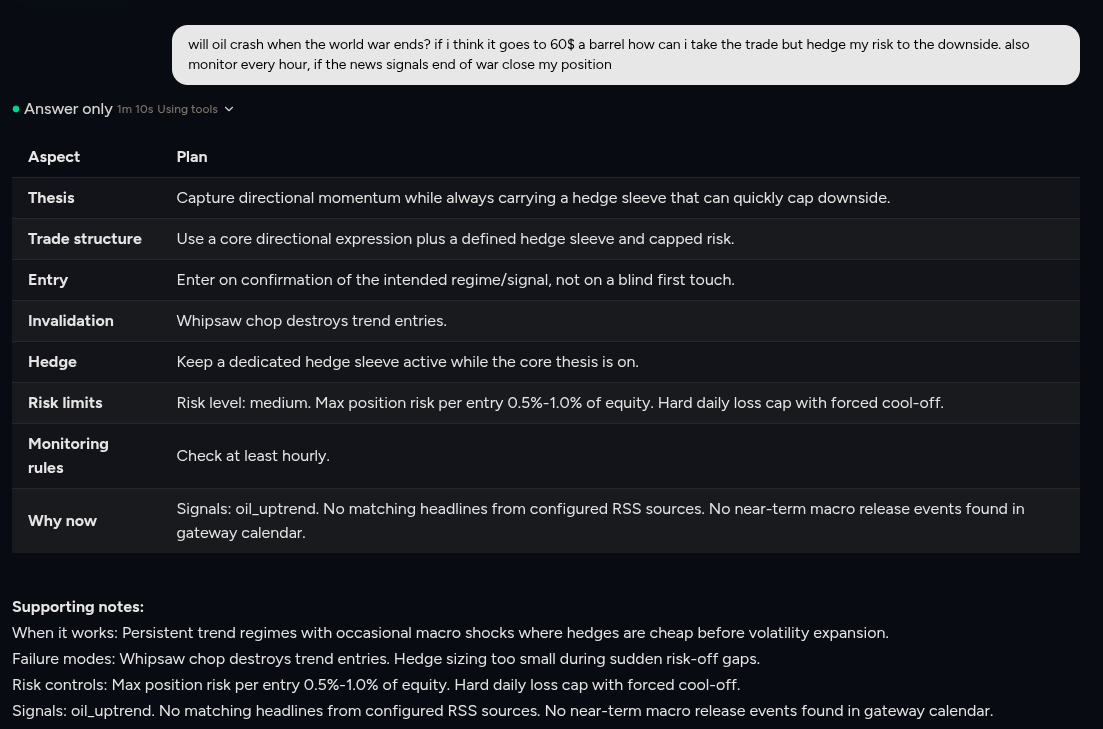
Once you approve the strategy, you can simply say: Create this strategy.
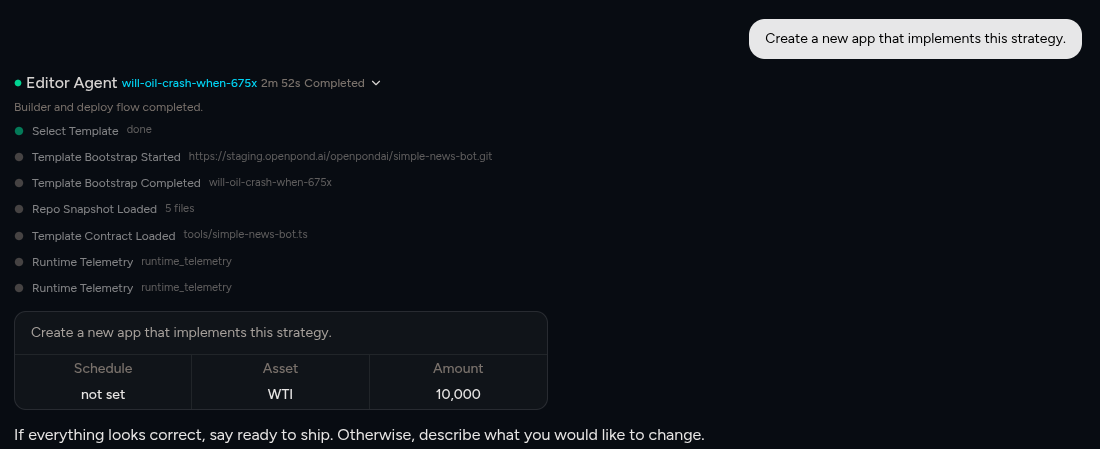
OpenPond AI then starts writing the agent for you.
From Prompt to Live Agent
OpenPond AI uses our open-source agent codebase, OpenTool, plus internal templates to build the agent from your prompt. OpenTool is optimized around the stack we care about most: Hyperliquid, Turnkey, and Polymarket.
We also provide a robust signal system for news-based event monitoring. It ingests multiple news sources, organizes them into event groups, and pairs them with Polymarket events so the model has structured context when it answers trading questions. On top of that, we support a growing set of technical analysis indicators and backtesting modes so you can test ideas before promoting them.
If you want to go beyond the defaults, that is the point. Your sandbox is your playground. You can connect your own news aggregator, your own Twitter or X search provider, your own settlement logic, or any external API you want to trade around.
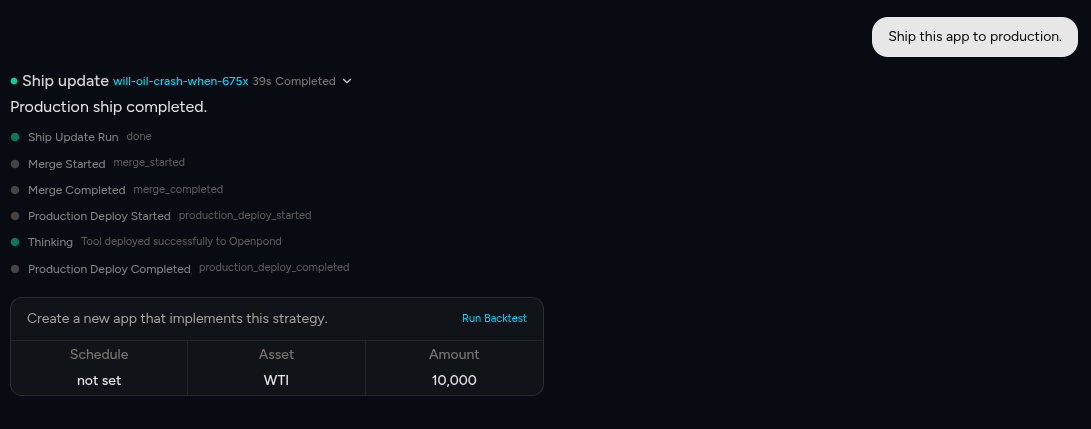
Once the code is ready, usually in about a minute, we deploy it automatically into your own serverless environment. A few seconds later, the agent is live with a config surface that lets you control position sizing, start and stop behavior, and whether open positions should be closed.
Git-Tracked, Backtestable, and Production Ready
Each agent is tracked in our internal git-backed repository system. That matters because it gives both you and OpenPond AI a clean development loop:
- inspect the code
- backtest changes inside the app
- iterate on new ideas
- merge improvements into production when ready
This is the gold standard for strategy development. The agent is not just a chat response. It is a real codebase with a history.
Full Visibility Into What Your Agent Is Doing
We also track granular agent events across decisions, execution, and lifecycle changes. That gives you a bird's-eye view into how the strategy is behaving in production, including funding and PnL tracking.
That visibility does two things at once:
- It helps you understand what your strategy is doing right now.
- It gives OpenPond AI better context to refine and improve your portfolio over time.
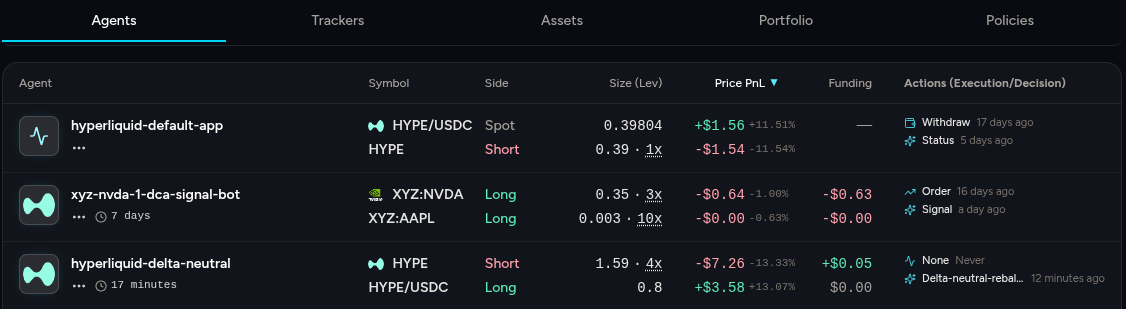
In a few clicks, you can have a news-driven or TA-driven agent running autonomously without babysitting a laptop, leaving a private key exposed, or manually rebuilding the same plumbing every time you have a new idea.
More Than a Single Trading Bot
There is much more to unpack with OpenPond AI and OpenTool.
Agents are hosted on HTTP endpoints and can surface x402. You can embed an agent into your web app. Agents can call other agents. You can get emailed from your agents. You can use our CLI in the same spirit as local coding-agent workflows. You can respond to custom event streams and operate on your own schedule.
The point is not one canned strategy.
The point is that once strategy logic is expressed in TypeScript inside a secure hosted environment, the design space opens up dramatically.
We have spent the last year and a half getting this stack right because it sits at the intersection of Web2 reliability, Web3 execution, and AI-native software development. Internally, we now have something that feels materially different from the rest of the AI x crypto landscape: fast agent creation, hosted execution, granular wallet controls, and code you can actually work with.
That is the world we are building for traders who would rather spend time finding edges than maintaining infrastructure.
Join Us
Discord is now open, and we are continuing to slowly open app access.
Join here: https://discord.gg/7uVsKJJSj8